
Surgical Robots
Endovascular Robots for Cardiac and Neurovascular Interventions
We develop compact, portable catheter robots that manipulate off-the-shelf catheters and guidewires for cardiac and neurovascular interventions, including stroke thrombectomy, embolization, percutaneous coronary intervention (PCI), and cardiac electrophysiology (EP) procedures. Our latest robot, LegoBot, is modular, compact, and device-agnostic. Each decoupled, instrument-agnostic 2-DOF actuation module translates and rotates off-the-shelf instruments from 0.33 to 3 mm in diameter. Three robotic modules with interchangeable adapters and a dedicated module coupler can be reconfigured for different neurovascular workflows, such as diagnostic angiography and aspiration thrombectomy.
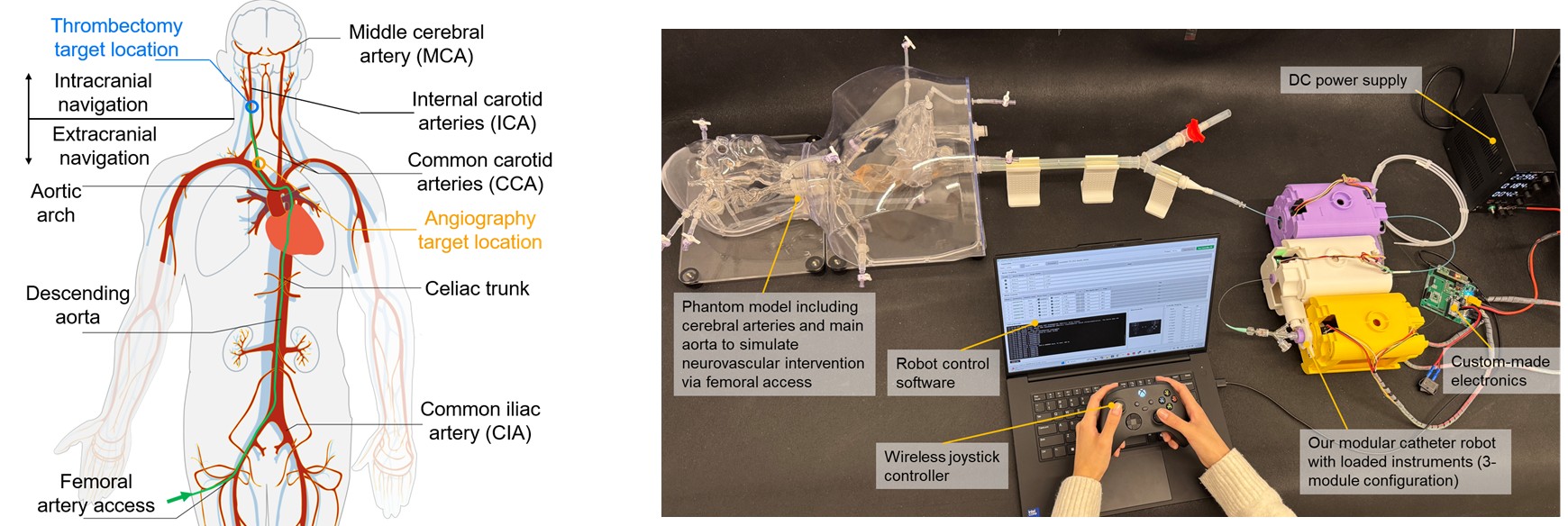
Each module carries one instrument, so the robot can be used in a 2-, 3-, or 4-module configuration with up to 4, 6, or 8 DOFs. Modules are assembled with quick-release fasteners, and an instrument can be exchanged by swapping a preloaded module. With direct-drive motors and a low-ratio transmission, the robot is fully backdrivable by hand for emergency safety.
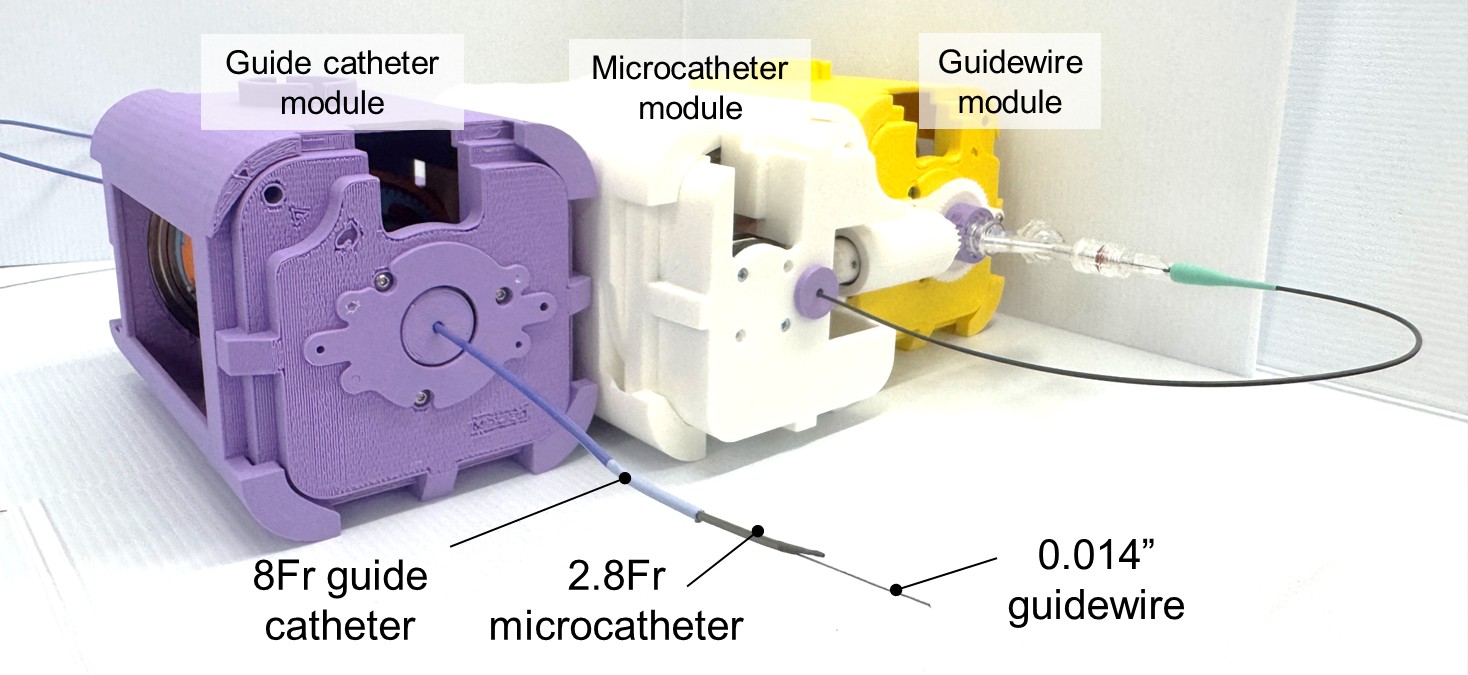
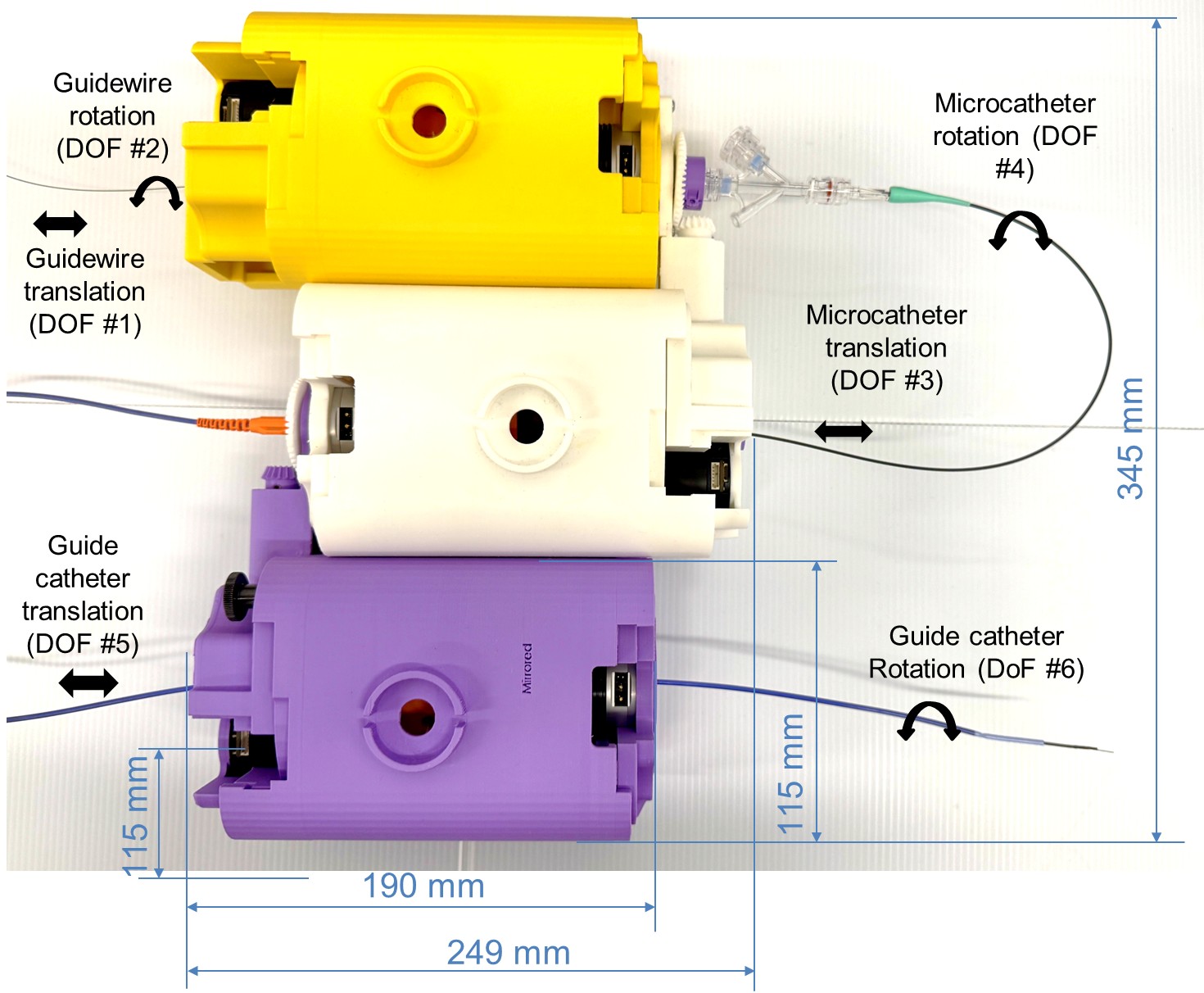
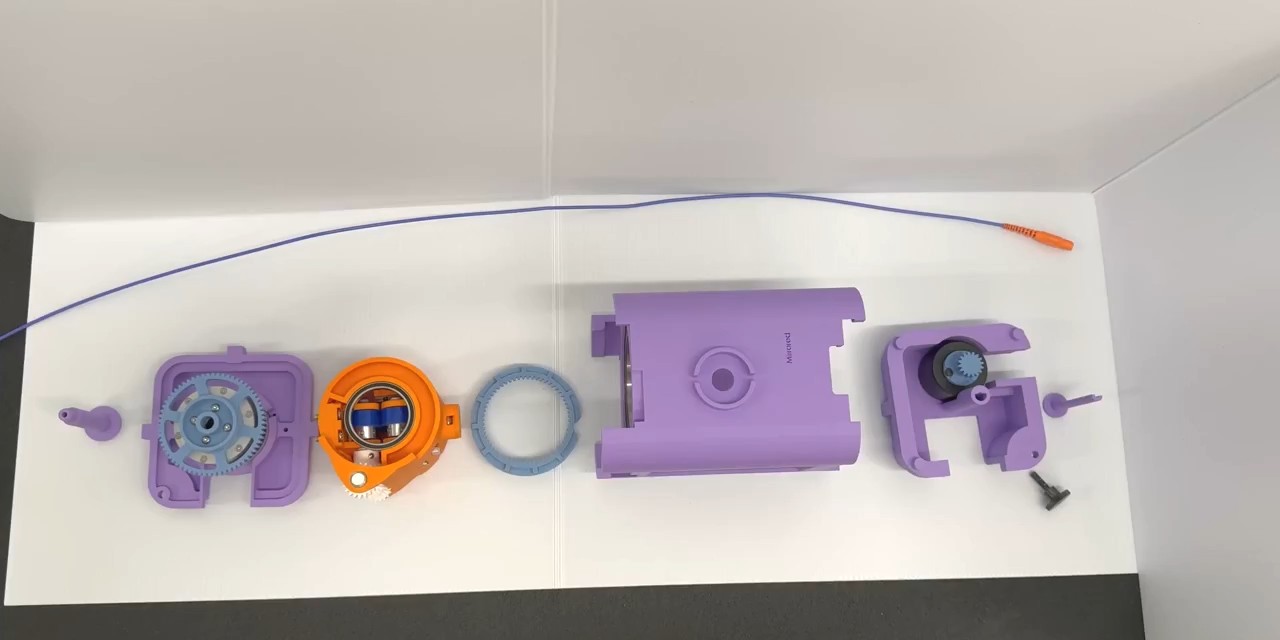
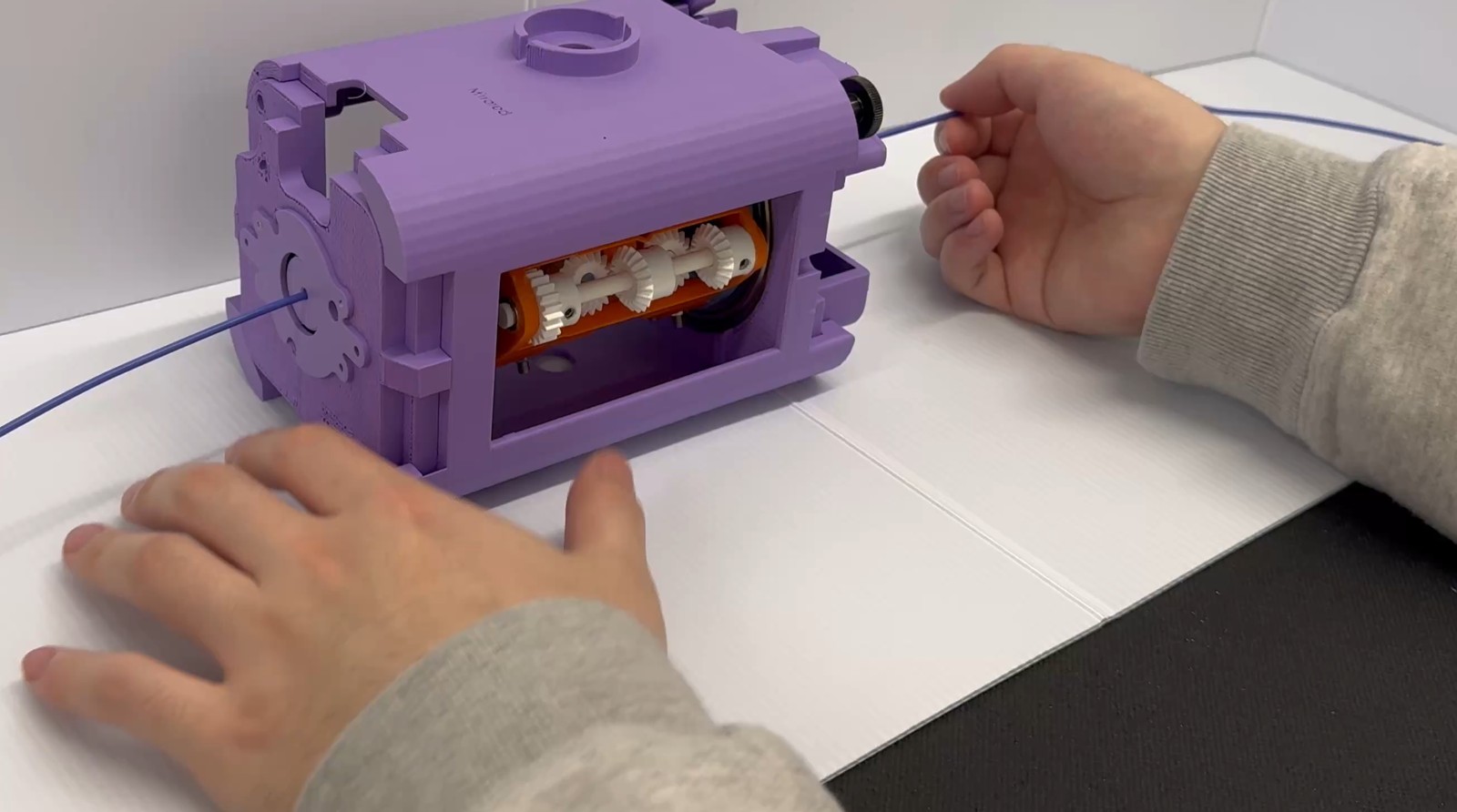
Top: guide catheter, microcatheter, and guidewire modules in a 3-module configuration (6 DOFs). Bottom left: quick assembly of one module from interchangeable parts. Bottom right: the module is backdrivable by hand.
Autonomous Surgical Robots via Learning in Simulation
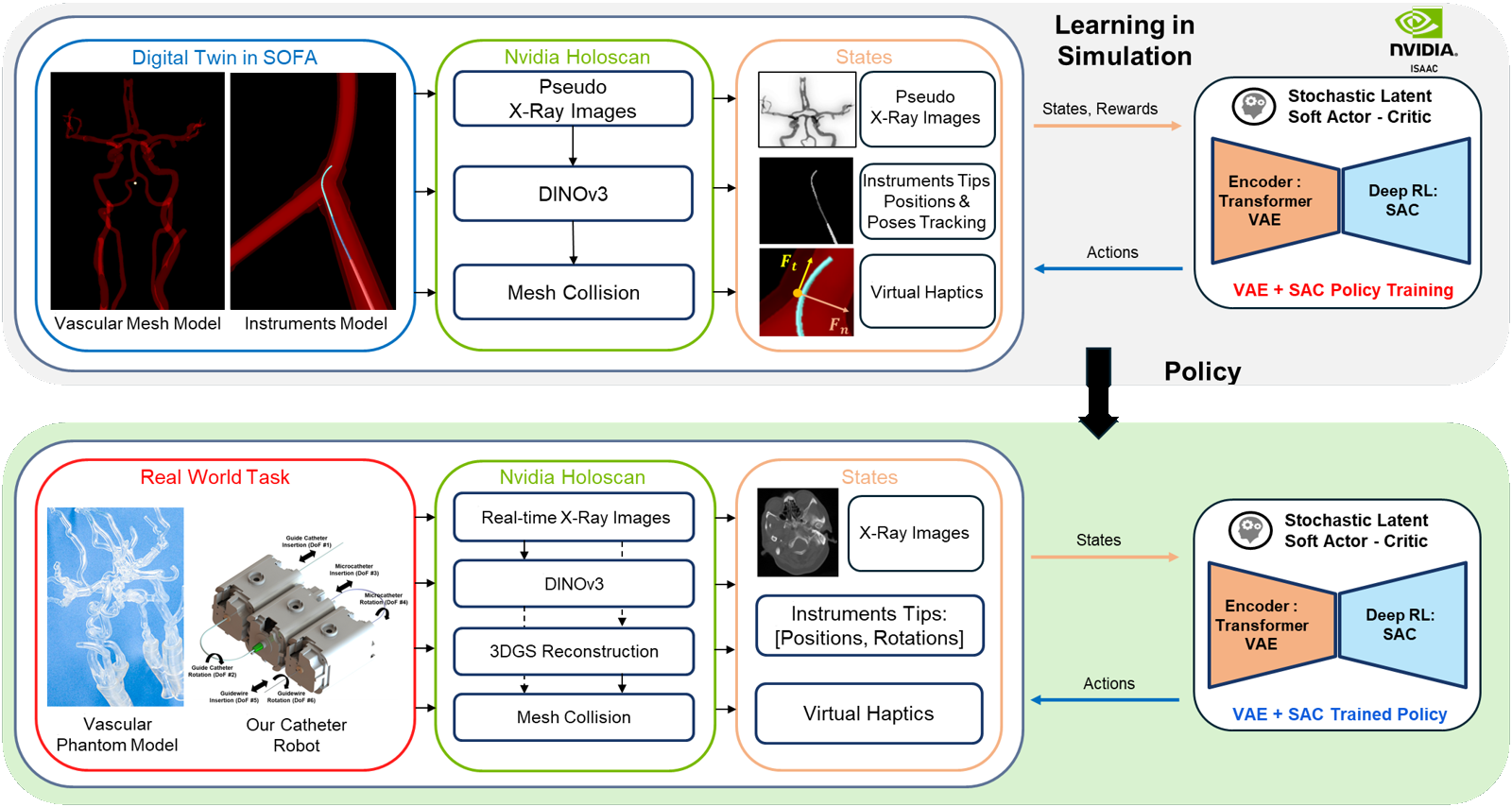
Navigating guidewires and catheters through tortuous vessels under X-ray guidance is demanding, prolongs procedure and fluoroscopy time, and makes outcomes highly operator-dependent. We develop autonomous surgical robots that learn these skills in simulation. In a physics-based digital twin of the patient’s vasculature, deep reinforcement learning agents learn to coordinate the guide catheter, microcatheter, and guidewire from pseudo X-ray images and virtual haptic feedback, without any risk to patients. The learned policies are then transferred to our catheter robot, where a vision foundation model segments the vessels and instruments in each real X-ray frame to close the loop.
Robot for Transnasal and Intracranial Endoscopic Neurosurgery
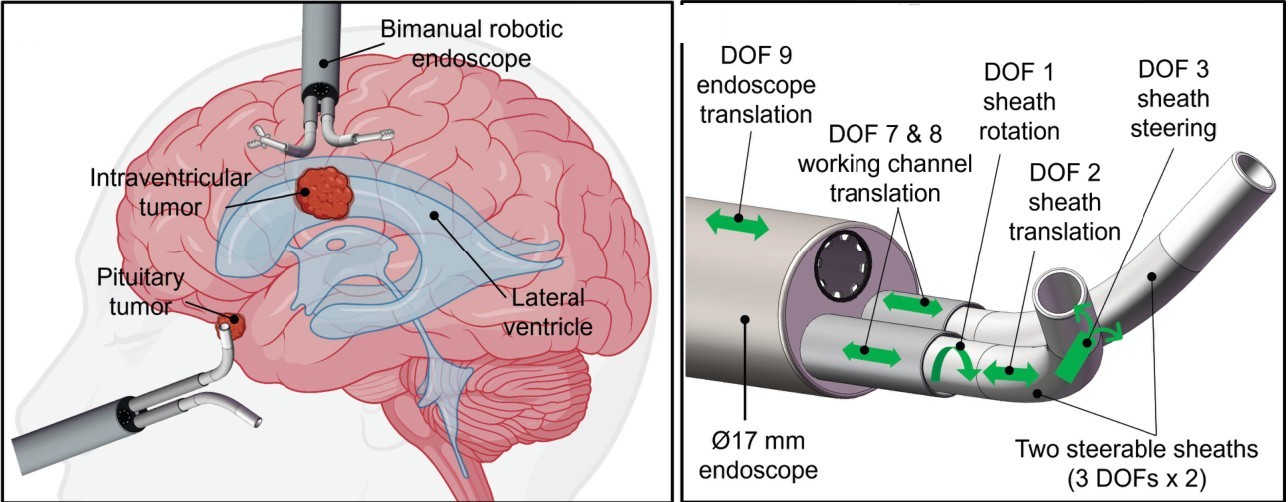
Endoscopic neurosurgery delivers two instruments and an endoscope through one narrow corridor, so the patient-side robot must stay small at the entry yet reach a large workspace at the target. We are developing a compact 9-DOF single-port endoscopic robot that motorizes two commercial push–pull steerable sheaths, carried in two independent working channels, together with the endoscope. Each sheath has independent translation, rotation, and steering, so the two instruments can retract and dissect tissue bimanually without pivoting the endoscope. A kinematic model of the transmission and the sheath delivery path decouples steering from rotation and predicts the tip workspace for intraventricular and pituitary tumor surgery.
Endoscopic Robot for Urology
We adapt the same steerable endoscopic design to transurethral surgery. The robot motorizes a commercial bidirectional steerable sheath with an 8.67 mm outer diameter that carries an endoscope camera with LED illumination, a laser fiber, and forceps. Mounted on a passive arm next to a standard resectoscope and teleoperated with a joystick, the compact, non-capital system aims to improve diagnostic and therapeutic yield in urologic procedures.
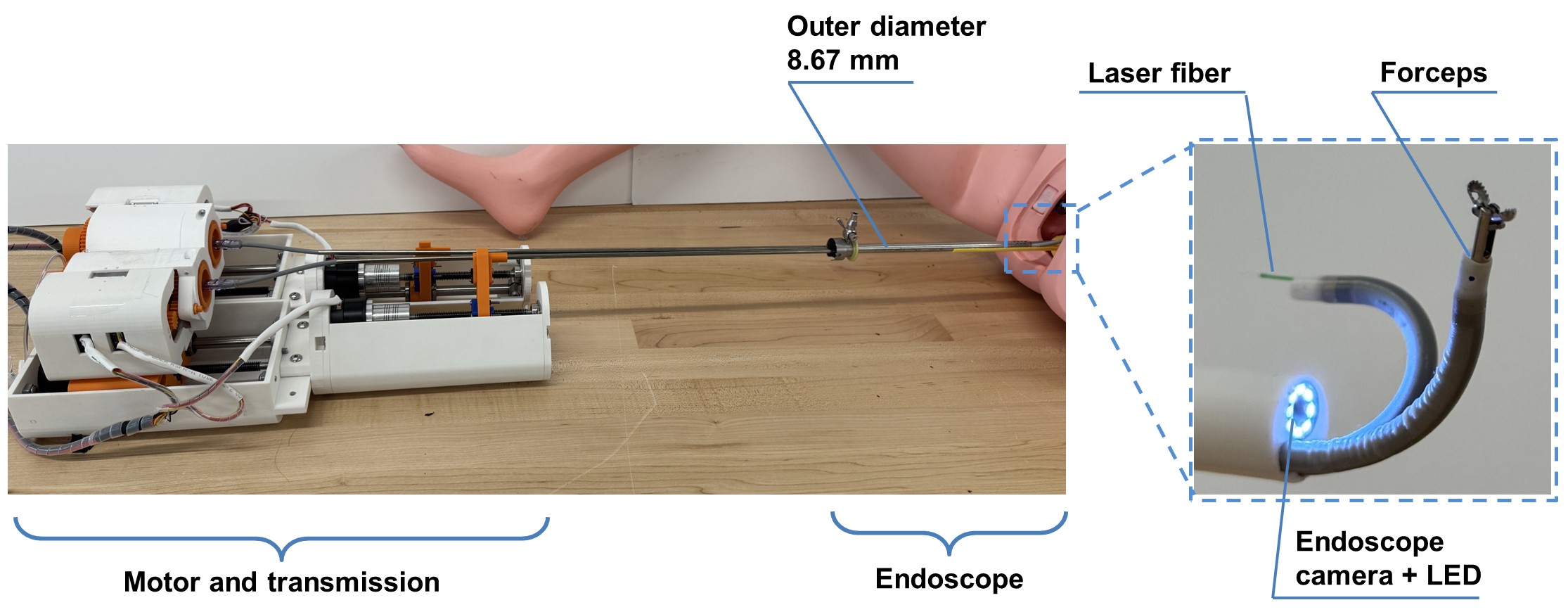
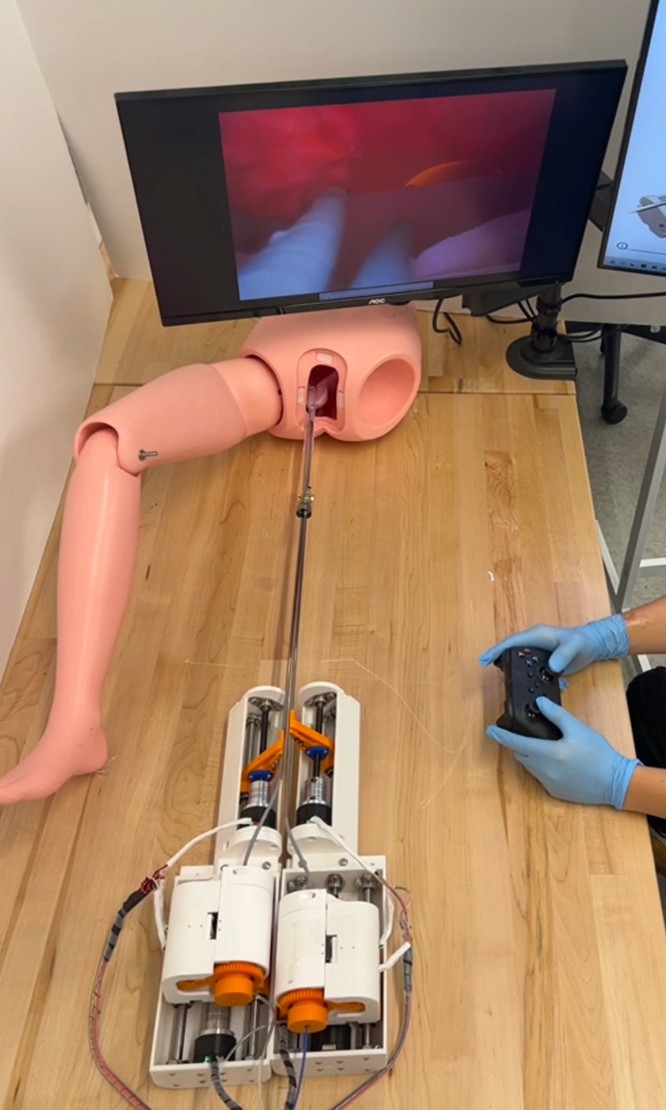
Left: endoscopic robot with motor and transmission, steerable sheath, laser fiber, and forceps. Right: joystick teleoperation in a pelvic phantom.
Earlier Work: MRI-Guided Robots
MRI-guided Robot for Neurosurgery
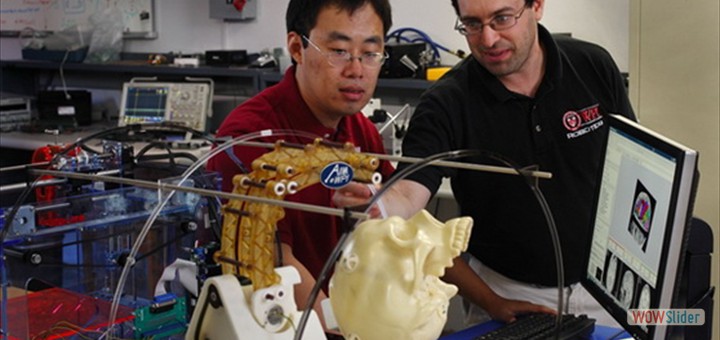
We have developed a master-slave telesurgery robot for MRI-guided robotic neurosurgery. This system consists of a piezoelectrically actuated slave robot for needle placement with integrated fiber optic force sensor utilizing Fabry-Perot interferometry sensing principle. A pneumatically actuated haptic master robot is developed to render force associated with needle placement interventions to the clinician. Teleoperated needle insertion has been demonstrated under live MR imaging to steer needle to multiple targets.
MRI-guided Robot for Prostate Interventions
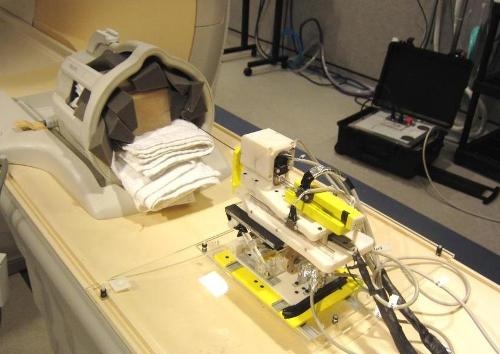
In collaboration with Harvard Medical School, we have developed three generations of MRI-guided prostate intervention robots in collaboration with Johns Hopkins and Brigham and Women's Hospital. The robotic system, designed to improve prostate cancer biopsies, is being tested as part of a larger clinical trial at BWH. The first generation is a cylindrical needle placement robot, the 2nd generation utilized a concentric tube mechanism to actively steer needles, and the third generation deploys a parallel mechanism for angulated needle placement. Prostate cancer is the last form of cancer still diagnosed with blind needle biopsies, so we are working to change that with image-guided technology.
Key Publications
- W. Gao, N. Srinivasan, D. Piao, Q. Fan, M. Guo, R. Li, P. Patalano, and H. Su, “LegoBot: Modular, compact, device-agnostic robot for endovascular catheter and guidewire manipulation in stroke thrombectomy,” IEEE/ASME Transactions on Mechatronics. 2026 [PDF] [Video] [GitHub]
- N. Kantu, W. Gao, N, Srinivasan, G. Buckner, and H. Su, "Portable and Versatile Catheter Robot for Image-Guided Cardiovascular Interventions," in IEEE/ASME Transactions on Mechatronics, 2025. [PDF] [Video] [GitHub]
- H. Su, K. Kwok, K. Cleary, J. Desai, I. Iordachita, C. Cavusoglu, G.S. Fischer, "State of the Art and Future Opportunities in MRI-Guided Robot-Assisted Surgery and Interventions," in Proceedings of the IEEE, vol. 110, no. 7, pp. 968-992, Jul. 2022. [PDF]
- H. Su, W. Shang, G. Cole, G. Li, K. Harrington, A. Camilo, J. Tokuda, C. M. Tempany, N. Hata, G. S. Fischer, "Piezoelectrically-Actuated Robotic System for MRI-Guided Prostate Percutaneous Therapy," IEEE/ASME Transactions on Mechatronics , vol.20, no.4, pp.1920-1932, 2015. [PDF]
- G. Li*, H. Su*, G.A. Cole, W. Shang, J. Pilitsis, and G. S. Fischer, “Robotic System for MRI-Guided Stereotactic Neurosurgery,” IEEE Transactions on Biomedical Engineering, vol. 62, no. 4, pp. 1077-1088, 2015 (*shared first authorship) [PDF]
- H. Su, W. Shang, G. Li, and G.S. Fischer, “An MRI-Guided Telesurgery System Using a Fabry-Perot Interferometry Force Sensor and a Pneumatic Haptic Device”, Annals of Biomedical Engineering, Aug;45(8):1917-28., 2017. [PDF]
See all publications.