
Dexterous Manipulation and Humanoid Robots
Agentic Robots for Long-Horizon Tasks
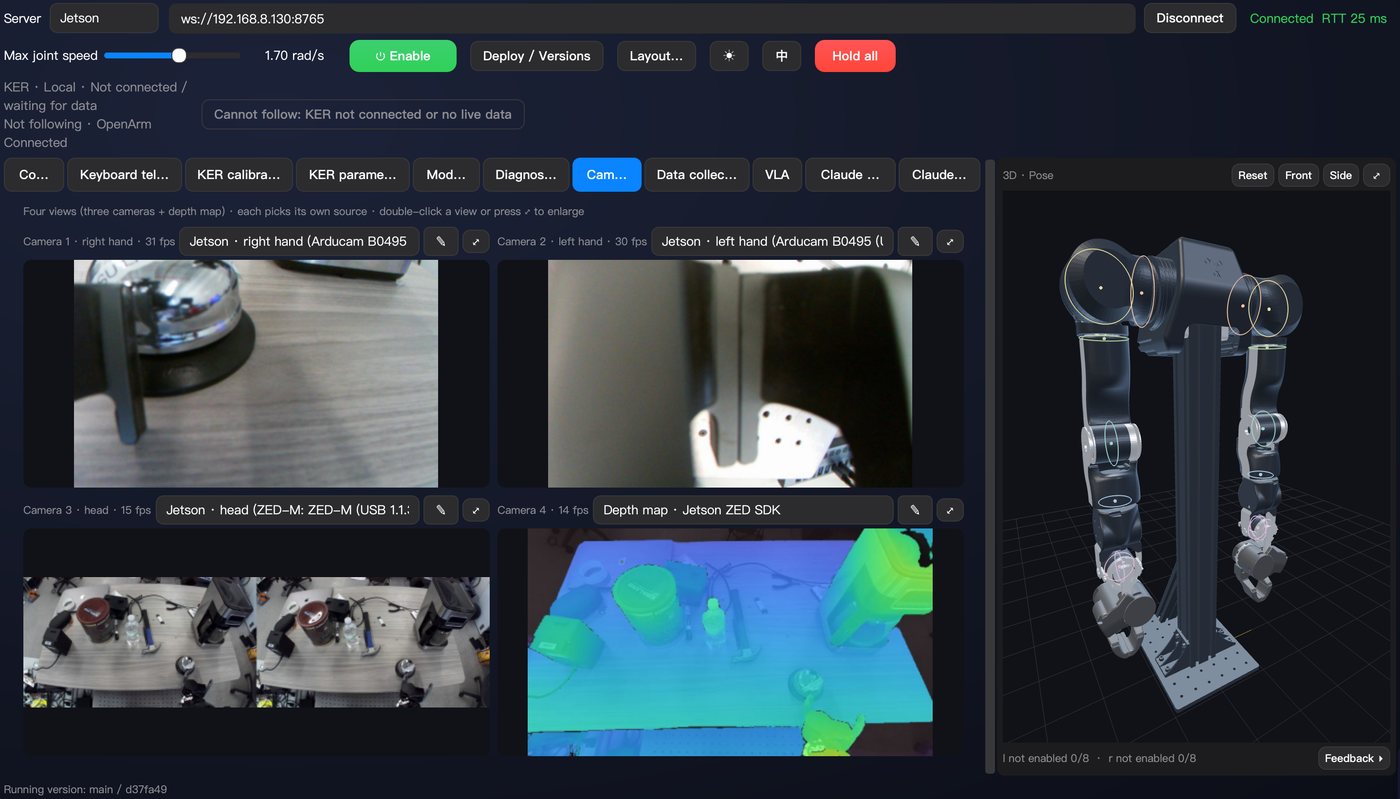
Everyday tasks such as making coffee or packing an order are long sequences of skills. We are building agentic robots in which a task-level agent sequences skills and retries or re-plans when a skill fails. Our platforms include a bimanual OpenArm with wrist, head, and depth cameras, an OpenArm KER teleoperation device for collecting demonstrations, and Booster K1 humanoid robots. See Robots for details.
Force-Aware World Model Manipulation for Logistics
Many packing steps in e-commerce fulfillment still depend on human hands because items are deformable, cluttered, and highly varied. We are applying force-aware world models to packing, starting with bag-in-bag packaging: one arm holds a mailer bag open while the other inserts small polybags without tearing or crushing them.
Robots for Food Service: Coffee Making
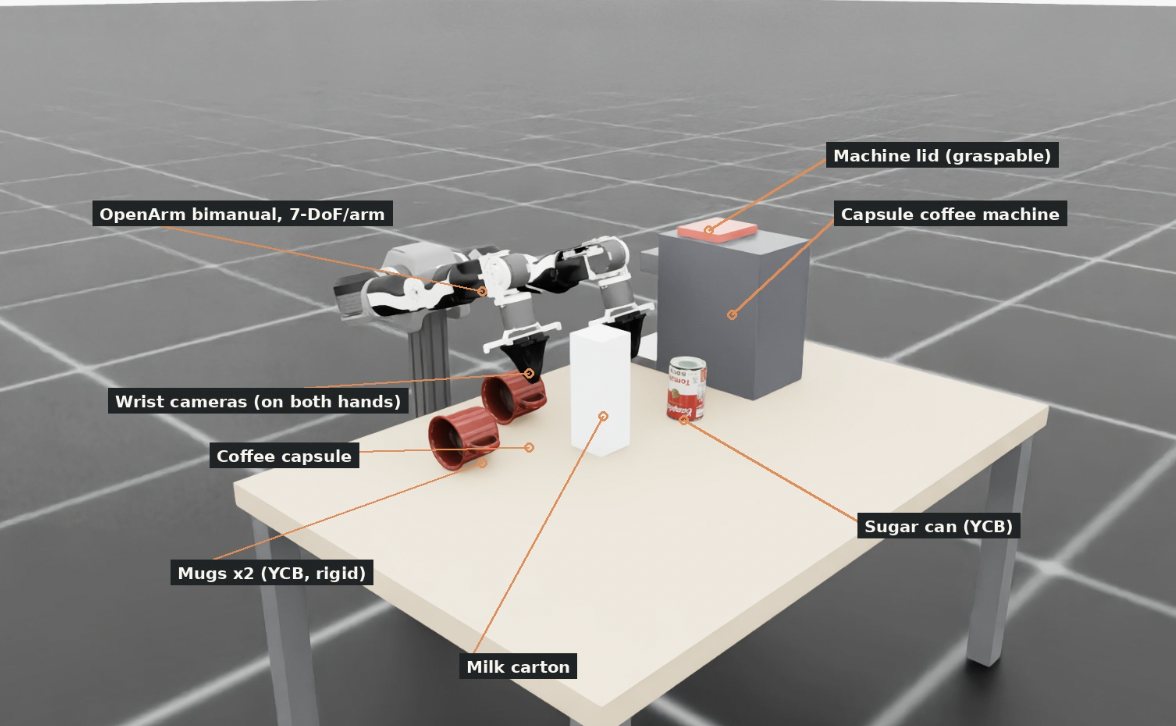
In our coffee-making project, a bimanual OpenArm learns to prepare drip coffee, a sequence of steps that require precise, force-aware contact. We build a simulated coffee-making scene to collect demonstrations labeled with contact force.
Humanoid Locomotion Control
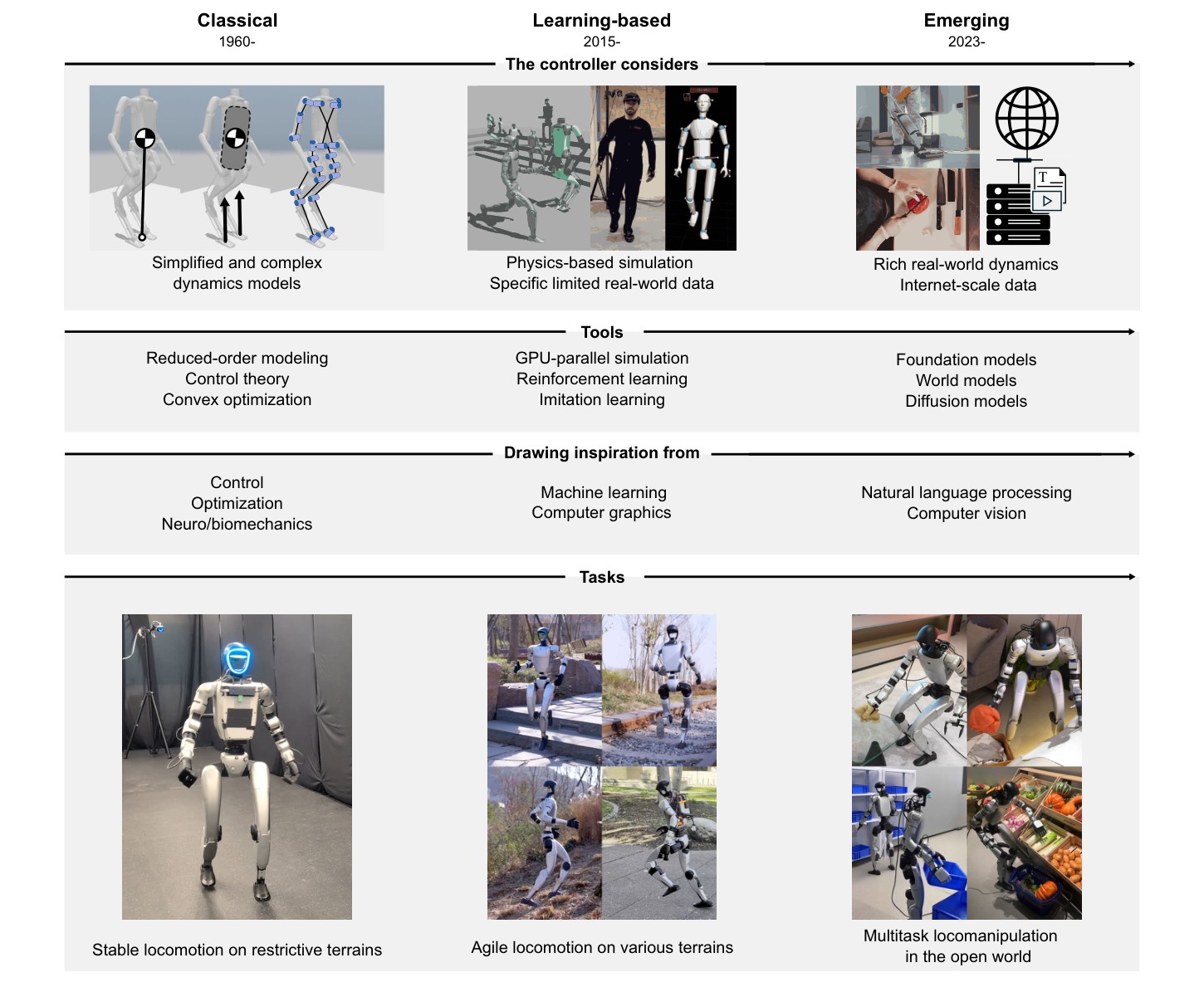
In our Science Robotics review with collaborators, we trace how humanoid locomotion control has evolved from classical model-based control and optimization, to reinforcement learning powered by large-scale simulation, and now to generative approaches such as foundation models and world models. We argue that these paradigms are converging toward physics-guided generative intelligence that combines physical modeling, constrained decision-making, and adaptation to uncertainty.
Key Publications
- Y. Gu, G. Shi, F. Shi, I.-C. Chang, Y.-J. Wang, Q. Cheng, Z. Olkin, I. Lopez-Sanchez, Y. Feng, J. Zhang, A. D. Ames, H. Su, and K. Sreenath, “Evolution of humanoid locomotion control,” Science Robotics, vol. 11, no. 117, Aug. 2026. [Full Text] [DOI]
- Soleymanzadeh D, Lopez-Sanchez I, Su H, Li Y, Liang X, Zheng M. Towards Generalist Neural Motion Planners for Robotic Manipulators: Challenges and Opportunities. IEEE Transactions on Automation Science and Engineering. 2026 Feb 3. [PDF]
- H. Su, Y. Cui, C. Della Santina, K. Fang, J. Kober, Y. Li, Y. Li, T. Matsubara, M. Pozzi, and B. Zhou, “Embodied AI: Bridging robotics and AI toward real-world applications,” IEEE Robotics & Automation Magazine, vol. 33, no. 1, pp. 6–7, Mar. 2026. [PDF]
See all publications.